
Learn
Understand how a moon calendar is built from real astronomical computation — lunar cycles, planetary motion, deterministic methods, and provenance.
Almanac Notes
Almanac Note
What Is a Moon Calendar?
A moon calendar follows the changing Moon through time. See how LuNAC expands that idea into a modern lunar calendar built from celestial cycles.
Almanac Note
Moon Calendar, Lunar Calendar, Lunar Almanac
A simple guide to the overlapping terms people use for following the Moon, lunar phases, and celestial cycles.
Almanac Note
A Calendar Built from the Sky
How LuNAC organizes the current Moon, lunar phases, planetary context, and celestial events into a usable calendar.
Almanac Note
Astronomy Engine: The Calculations Behind LuNAC
How astronomical calculations become calendar entries, with clear sources, event timing, observer context, and provenance.
What Is a Modern Lunar Almanac?
A modern lunar almanac is a computational tool that presents deterministically calculated astronomical cycles in calendar and timeline interface formats. Unlike traditional paper almanacs that relied on pre-printed tables, modern almanacs compute celestial events in real time from ephemeris models.
This approach ensures precision and allows for features traditional almanacs could not provide: device timezone support, continuous updates, and provenance tracking for every computed event.
Understanding Lunar Cycles
Lunar Phases
Follow the changing view of the Moon’s sunlit side, from new moon through full moon and back again.
Explore the visual guidePerigee and Apogee
Learn why the Moon’s distance changes and what its nearest and farthest orbital points mean.
Explore the visual guideLunar Nodes
Explore the Moon’s orbital crossings and why being near a node matters for an eclipse.
Explore the visual guideEclipses
Compare solar and lunar eclipses and see why they do not happen at every new and full moon.
Explore the visual guideDeterministic Computation
Deterministic computation means that celestial events are computed directly from mathematical models of planetary motion. Every timestamp in LuNAC is derived from ephemeris data — precise tables of celestial body positions.
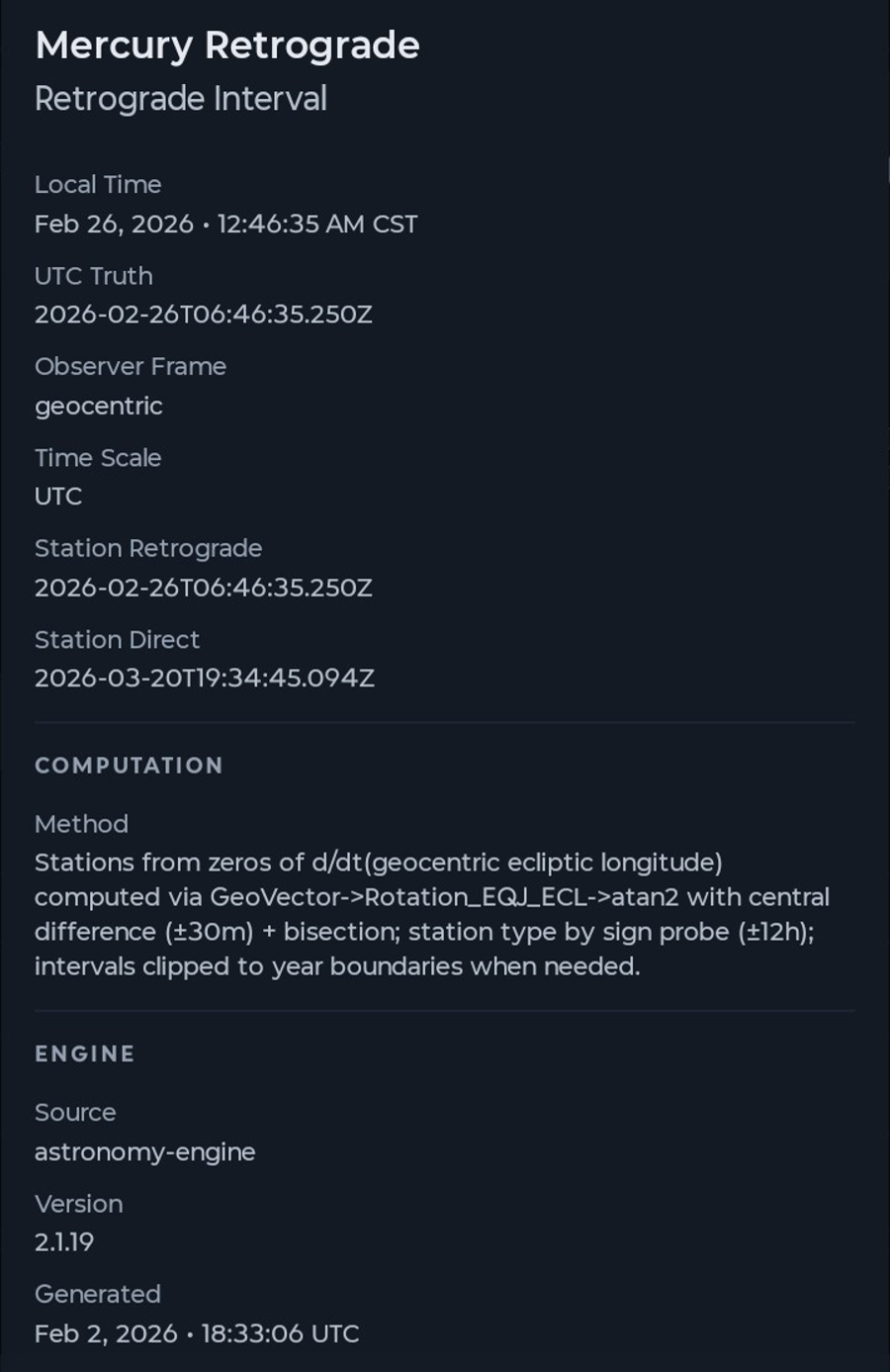
LuNAC uses astronomy-engine (v2.1.19) as its core ephemeris library, implementing VSOP87-series algorithms and NOVAS-validated methods. Each computed event is recorded with UTC time, method, engine version, observer frame, and provenance.
This approach ensures:
- Accuracy: Events are calculated, not estimated
- Provenance: Every event can be traced to its computational source
- Transparency: The method is knowable and verifiable
- Consistency: The same input always produces the same output
Use Case Examples
Gardening and Land-Based Practice
Lunar almanacs have historically been used for agricultural timing. While the mechanisms are not fully understood, lunar phase correlations with moisture patterns and growth cycles have been observed and recorded across cultures. LuNAC provides accurate phase timing for those who integrate celestial observation into land-based practice.
Seasonal and Ritual Practice
Many individuals observe seasonal markers, sabbats, or personal rituals aligned with celestial cycles. LuNAC offers precise timing for these practices — celestial positions and UTC-based event timestamps from deterministic astronomical computation. Users bring their own meaning; LuNAC provides the computational foundation.
Observational Learning
Some users simply wish to understand the sky's patterns. LuNAC serves as an educational tool for learning about lunar cycles, planetary motion, and the mechanics of eclipses through direct observation supported by accurate timing.